

A Compact Controller for the Real World
Designed for real 12 V and 24 V systems, PicoLC brings protected field I/O, flexible output modes, expansion, and modern programming tools into one compact platform.
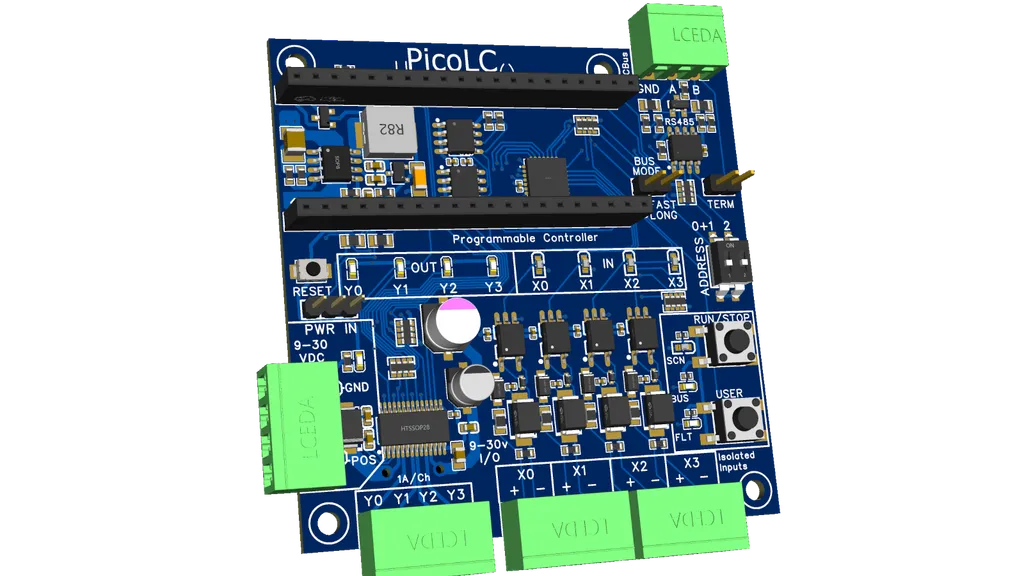
Features
Industrial-Style I/O. Pico-Class Flexibility
Four isolated inputs, four configurable outputs, RS-485 expansion, and support for both browser-based and native development workflows.
Isolated 9-30 V Inputs
Four independently isolated digital inputs interface safely with common 12 V and 24 V sensors, switches, and control signals.
Software-Configurable Outputs
Each output can operate as high-side, low-side, push-pull, PWM, or paired motor control without changing the hardware.
Built for 12 V and 24 V Systems
PicoLC is designed for the voltage ranges commonly used in automation, vehicles, access control, and embedded projects.
Expandable with LCBus
Add remote or local I/O over a robust RS-485 expansion bus without replacing the main controller.
Raspberry Pi Pico Flexibility
Compatible with Raspberry Pi Pico modules, including the W, 2, and 2W variants, allowing you to choose the processing and connectivity options that best suit your project.
Browser-Based Programming
Create, simulate, and load control programs directly from your web browser without installing a development environment.
FAQs
Frequently Asked Questions
What is included in the early-access release?
The early-access version includes the assembled PicoLC controller board. It is intended for developers and technically experienced users who want to evaluate the hardware before the final retail package is available. A Raspberry Pi Pico module and pluggable terminal blocks are not included with the early-access board.
How is the early-access version different from the final product?
The early-access hardware is functionally representative of the planned production version, but the packaging, enclosure, documentation, software, and included accessories may still change.
What software is available at launch?
PicoLC can be used through the initial Arduino support and direct Raspberry Pi Pico development tools. The browser-based programming environment and PLC-style runtime are still under development.
Do I need programming experience?
For the early-access release, yes. Buyers should be comfortable working with microcontroller development tools, wiring field devices, and reading technical documentation.
Which Raspberry Pi Pico boards are supported?
The full release will likely come with a Raspberry Pi Pico 2 W pre-installed. Other Pico variants, including the original Pico and the Wiznet W5500-EBC-Pico are hardware compatible but may not support the full software feature set.
What voltages does PicoLC support?
PicoLC is designed for 12 V and 24 V systems, with power input and field I/O operating across the documented 9-30 V range. It is not intended to connect directly to mains voltage.
What can the outputs drive?
Each output supports up to 1 A continuous current and can be configured for high-side, low-side, push-pull, PWM, or paired motor-control operation, subject to the documented electrical limits.
Are the inputs and outputs isolated?
The four digital inputs are independently optically isolated. The outputs and controller power are not galvanically isolated from each other.
What is LCBus?
LCBus is PicoLC’s RS-485 expansion interface for adding local or remote I/O modules. Early-access hardware includes the physical interface, while expansion modules and higher-level software support may still be in development.
Is the hardware open source?
The PicoLC hardware design and compiler are planned for open release. Some hosted services, including the browser IDE and related backend systems, will remain proprietary.
Will early-access units receive software updates?
Yes. Early-access units are intended to remain compatible with ongoing firmware and tool updates, although features and interfaces may change during development.
What support is included?
Early-access support will focus on hardware issues, setup problems, and documented software features. It does not include custom application design or integration consulting.
Can I use PicoLC in a safety-critical system?
No. PicoLC is not certified for life-safety, medical, automotive safety, or other applications where failure could cause injury or significant property damage.
When will the final version be available?
The final version will follow after the hardware, firmware, and documentation have been validated through early-access use. A firm release date has not yet been announced.